Wartime urgency followed by pure theoretical ambition. Mathematicians and logicians shifted from asking whether a machine could calculate faster than a human to asking whether a machine could fundamentally think.
3 chapters · 10 min · 2,187 words
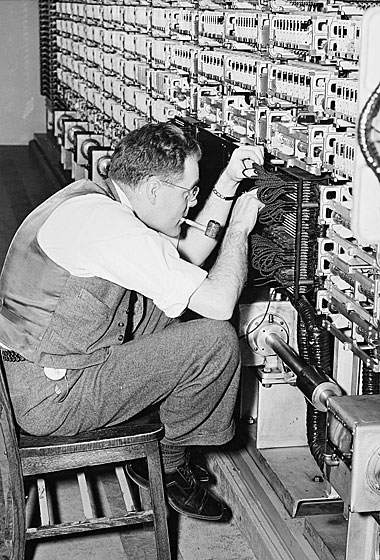
Electromechanical decryption hardware used at Bletchley Park to systematically eliminate German Enigma cipher keys.
The foundational benchmark for machine intelligence, based on conversational indistinguishability.
John McCarthy's high-level language for symbolic manipulation and early AI research.
A 4,000-pound robotic arm at General Motors moving die castings: the world's first industrial robot.
A script-driven chatbot that mimicked a Rogerian psychotherapist by reflecting inputs back as questions.
The first general-purpose mobile robot able to perceive its environment, parse spatial goals, and plan paths.
Alan Turing and the Universal Engine
In the late spring of 1935, a twenty-two-year-old Cambridge mathematical fellow named Alan Turing lay breathless in the clover of Grantchester Meadows. He had just finished a punishing long-distance run along the River Cam. Turing was a solitary, eccentric athlete whose mind achieved clarity not in crowded seminar rooms, but in the rhythm of his own pounding heartbeat and solitary strides.
Lying in the grass, his mind turned over an arcane challenge that had cast a long shadow over European mathematics: the Entscheidungsproblem, or “decision problem,” posed in 1928 by David Hilbert. Hilbert had dreamed of establishing mathematics on an unshakeable foundation of complete, consistent, and decidable logic. He asked: Could there ever exist a mechanical, step-by-step procedure—an effective method, an algorithm—that could take any well-defined mathematical assertion and definitively decide whether it was provable?
In 1931, Kurt Gödel had shattered Hilbert’s first dream with his Incompleteness Theorems, proving that any formal axiomatic system capable of arithmetic contains truths that cannot be proven within the system itself. But the decision problem remained an open wound.
To resolve it, Turing did not draft an equation of conventional symbols. Instead, in his landmark 1936 paper, On Computable Numbers, with an Application to the Entscheidungsproblem, he constructed a thought experiment: an imaginary mechanical device.
Imagine an infinite strip of paper tape divided into discrete squares. A scanning head moves back and forth over the tape, reading symbols, erasing them, printing new ones, and shifting left or right according to a finite internal lookup table. Turing demonstrated that this theoretical apparatus—the Turing Machine—could execute any conceivable mathematical computation that could be broken down into finite mechanical steps.
More profoundly, Turing proved the existence of a Universal Turing Machine.
Prior to 1936, calculating machines were purpose-built artifacts. An adding machine could add; a mechanical loom wove patterns dictated by punched cards. If you wanted a machine to perform a different task, you had to physically alter its brass gears, levers, and circuits.
Turing turned that paradigm inside out. A Universal Turing Machine did not possess fixed internal functions. It was capable of reading the description of any other specific computing machine encoded as symbols upon its tape, simulating that machine’s actions step by step, and producing the identical result. In that single, astonishing theoretical leap, Alan Turing invented the concept of the general-purpose stored-program computer. The physical machine (the hardware) could remain entirely static; the instructions inscribed upon the tape (the software) would endow it with infinite behavioral variability. Turing then delivered the coup de grâce to Hilbert’s Entscheidungsproblem: he proved the undecidability of the Halting Problem, demonstrating that no general algorithm could ever inspect an arbitrary computer program and determine whether it would eventually halt or run forever.
When World War II broke over Europe in September 1939, Turing’s abstract logic was hurled into a mortal arena.
At Bletchley Park, the Victorian estate housing Britain’s Government Code and Cypher School, German military communications were encrypted by the Enigma machine—an electromechanical field cipher device equipped with rotating polyalphabetic rotors and a front plugboard generating roughly 158 quintillion () possible key settings daily. Human cryptanalysts were mathematically paralyzed.
Turing recognized an immutable law of the coming era: Only a machine can defeat a machine.
Working in Hut 8, Turing—collaborating with Gordon Welchman and Harold Keen—designed an industrial electromechanical behemoth known as the Bombe. Measuring seven feet tall and weighing over a ton, the Bombe consisted of thirty-six miniature Enigma simulators spinning on bronze shafts. Operating on “cribs”—short stretches of intercepted ciphertext where cryptanalysts could guess probable underlying words like German weather reports (“WETTERVORHERSAGE”)—the Bombe used electrical circuits to search for logical contradictions, eliminating quintillions of permutations in minutes.
Turing’s mechanical reasoner cracked the German Naval Enigma, allowing Allied commanders to track U-boat wolfpacks stalking Atlantic convoys. Historians estimate the intelligence produced at Bletchley Park shortened the war in Europe by more than two years and saved over fourteen million lives.
Yet even amid wartime secrecy, Turing’s gaze was fixed on a more expansive horizon: the nature of intelligence itself.
In 1950, working at the University of Manchester, Turing published a paper in Mind that permanently altered human self-perception: Computing Machinery and Intelligence.
Its opening sentence was an intellectual broadside:
“I propose to consider the question, ‘Can machines think?’”
To bypass semantic quicksand, Turing proposed the “Imitation Game,” forever remembered as the Turing Test. A human interrogator in an isolated room communicates via text with two hidden respondents: one human, one computer. If the interrogator cannot reliably distinguish between them after five minutes of interrogation, Turing asserted it was intellectually dishonest to deny that the machine was demonstrating functional intelligence.
Turing systematically demolished every counterargument: Lady Lovelace’s claim that machines cannot originate anything, the argument from consciousness, and theological objections. He predicted that by the year 2000, computers with a gigabyte of storage would play the imitation game so convincingly that an average interrogator would have no more than a seventy percent chance of correct identification.
Turing did not live to see his prophecy fulfilled. In 1952, he was arrested and convicted under Britain’s anti-homosexuality statutes, stripped of security clearances, and subjected to chemical castration. On June 7, 1954, forty-one-year-old Alan Turing was found dead beside an apple laced with potassium cyanide. The man who laid the foundations of digital civilization had been broken by the nation he preserved.
McCulloch, Pitts, and the First Neural Net
While Turing approached machine intelligence from the summit of mathematical logic, two men in Chicago mounted an assault from the opposite direction: bottom-up, through the tangled biology of the brain.
In 1943, eccentric neurophysiologist Warren McCulloch and homeless teenage mathematical prodigy Walter Pitts published a paper that founded the field of Artificial Neural Networks (ANNs): “A Logical Calculus of the Ideas Immanent in Nervous Activity.”
Their partnership was one of the most improbable in the history of science. McCulloch was a bohemian patriarch who slept four hours a night, drank whiskey, and debated metaphysics. Pitts was a shy, neglected runaway from the slums of Detroit who had spent his childhood hiding in public libraries. At twelve, Pitts read Bertrand Russell and Alfred North Whitehead’s Principia Mathematica, sent Russell a letter pointing out several subtle logical errors, and received an invitation to Cambridge. Lacking funds, Pitts ran away to Chicago at fifteen, living on pennies and auditing lectures in silence until McCulloch took the destitute prodigy into his household.
McCulloch and Pitts shared an intoxicating conviction: that the brain’s power did not stem from some mystical vitalistic soul, but from an underlying computational grammar.
Examining neurophysiological discoveries, they recognized that a biological neuron is essentially a binary threshold switch. Dendrites receive electrochemical pulses across synaptic clefts. If the aggregate sum of excitatory signals exceeds an inhibitory threshold at the axon hillock, the neuron depolarizes, firing an action potential down its axon. If it falls short, it remains inert. Zero or one. True or false.
They constructed an idealized mathematical abstraction of a neuron. Each artificial node received multiple binary inputs (). Each input was multiplied by a fixed connection weight. The node summed these inputs; if the total sum exceeded a predetermined threshold , the node emitted a 1; otherwise, it emitted a 0.
With rigorous mathematical proofs, McCulloch and Pitts demonstrated that by wiring networks of these threshold units together in feedforward and feedback loops, one could compute any logical truth table: AND, OR, NOT. If a function could be computed by a finite Turing Machine, it could be implemented by an artificial neural network. The human mind was an electrical network computing its own reality.
Yet the McCulloch-Pitts model could not learn; its weights were hand-wired into place by an external designer.
Fifteen years later, in 1958, an ambitious research psychologist at the Cornell Aeronautical Laboratory in Buffalo, New York, set out to breathe life into those static circuits: Frank Rosenblatt.
Rosenblatt, a charismatic polymath who studied cognitive psychology, astronomy, and biology, believed passionately that human intelligence could not be replicated through rigid top-down programming. Backed by funding from the US Office of Naval Research, Rosenblatt unveiled the Mark I Perceptron.
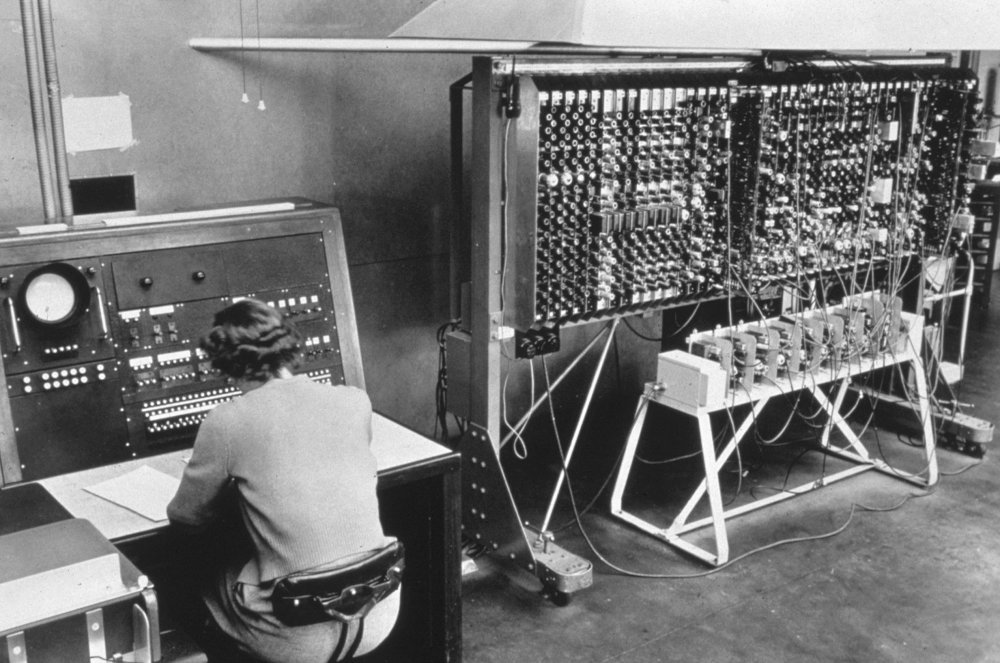
The Perceptron was an imposing physical machine of custom electrical hardware. Its “eye” consisted of an optical focal plane containing four hundred cadmium-sulfide photocells arranged in a 20x20 grid, mimicking the human retina. These photocells were wired through tangled cables to potentiometers—variable resistors driven by small electric servomotors. These potentiometers represented synaptic weights.
When the Perceptron was presented with an image—for instance, a white cardboard square with an ‘X’ or an ‘O’ stenciled onto it—photocells detected light patterns and transmitted electrical currents through the potentiometers to summing units. If the machine produced an incorrect classification, an operator did not rewrite code.
Instead, Rosenblatt instituted the Perceptron Learning Algorithm.
The machine applied electrical negative feedback: servomotors physically rotated the potentiometer dials. If a connection contributed to a false positive, its dial turned to increase electrical resistance, weakening the link; if it contributed to a correct signal, it strengthened. The Mark I Perceptron was learning directly from sensory experience through iterative trial and error.
In July 1958, The New York Times reported on Rosenblatt’s demonstration under a breathless headline:
“The Navy revealed the embryo of an electronic computer today that it expects will be able to walk, talk, see, write, reproduce itself and be conscious of its existence… The machine would be the first non-biological system capable of what he called ‘an original idea.’”
Rosenblatt toured the country giving charismatic lectures, predicting that perceptrons would soon navigate spacecraft, read handwritten manuscripts, and diagnose complex medical diseases. But his meteoric rise ignited fierce intellectual hostility from the high priests of mathematical logic.
Two years before Frank Rosenblatt unveiled the Perceptron, during the hot summer of 1956, twenty scientists met on the top floor of Dartmouth Hall in Hanover, New Hampshire.
The gathering was organized by assistant mathematics professor John McCarthy, joined by Marvin Minsky, Claude Shannon, and Nathaniel Rochester. Their funding proposal to the Rockefeller Foundation gave the field its permanent name:
“We propose that a 2 month, 10 man study of artificial intelligence be carried out during the summer of 1956 at Dartmouth College… The study is to proceed on the basis of the conjecture that every aspect of learning or any other feature of intelligence can in principle be so precisely described that a machine can be made to simulate it.”
Dartmouth established the reign of Symbolic AI (GOFAI). McCarthy, Minsky, Allen Newell, and Herbert Simon believed human cognition was fundamentally the formal manipulation of discrete physical symbols according to rules of deductive logic: If Socrates is a man, and all men are mortal, Socrates is mortal.
To the symbolic camp, connectionist neural networks looked like crude alchemy. Why tinker with messy analog voltages and noisy potentiometer dials when you could write pristine, transparent rules of formal logic?
The philosophical rift hardened into a fierce turf war for prestige and federal defense research grants. At the center of the conflict stood Marvin Minsky.
Minsky, who co-founded the prestigious MIT Artificial Intelligence Laboratory in 1959, had actually built one of the earliest primitive vacuum-tube neural net simulators—the SNARC—as an undergraduate in 1951. Having built it, Minsky concluded that neural networks were a computational dead-end: intractable, impossible to inspect, and fundamentally incapable of higher-order reasoning.
In 1969, Minsky joined forces with mathematician Seymour Papert to publish a devastating mathematical treatise: Perceptrons: An Introduction to Computational Geometry.
Minsky and Papert analyzed the exact geometric limitations of single-layer perceptrons, delivering their lethal demonstration on the Exclusive-OR (XOR) function.
An AND gate outputs 1 only when both inputs are 1. An OR gate outputs 1 when either input is 1. Both functions are linearly separable: on a two-dimensional Cartesian plane, a single straight line easily divides the positive from negative coordinates. But the XOR function outputs 1 if either input is true, but 0 if both are true or both are false. When plotted, the positive outputs sit on opposite diagonal corners. It is mathematically impossible to draw a single straight line that separates the classes. The XOR function requires at least one intermediate hidden layer to warp the coordinate space.
Crucially, Minsky and Papert conjectured that extending perceptrons into multi-layered architectures was mathematically sterile, arguing that there existed no viable algorithm to train the hidden weights without hitting combinatorial explosion.
The effect was catastrophic. Defense agencies slammed their checkbooks shut. In 1973, Sir James Lighthill delivered his scathing Lighthill Report to the British Science Research Council, concluding that AI had failed to achieve its grand promises. Government funding for neural networks evaporated across the United States, Britain, and Europe.
To mention “neural networks” in an academic proposal became professional suicide. On his forty-third birthday in July 1971, Frank Rosenblatt drowned in a boating accident in Chesapeake Bay, believing his life’s work had been permanently discredited.
The First AI Winter descended. The laboratories fell dark. But deep in the academic underground, a tiny band of stubborn heretics refused to abandon the dream.